
Article by
Eszter Pontenagel

For trading companies entering energy markets, timing can make or break a strategy. Margins are getting thinner, volatility remains high, and the cost of capital has risen, making portfolio diversification more important than ever.
At the same time, new players, from hedge funds and investment banks to utilities expanding internationally, are entering power and gas markets. This raises competition, but it also brings more liquidity to energy markets. For companies considering power or gas markets, now is the time to move while the opportunity is still developing and before the markets become more crowded.
In this article, we'll look at what really sets a market entry timeline: why regulation is rarely the main barrier, which decisions shape your timeline before your first submission, and what separates entrants who are live and trading within months from those who spend years working through avoidable obstacles.
Depending on the complexity of the market you are trying to enter, we can have you up and running in anywhere between 3 and 12 months. Of course, these market access timelines are shorter than many expect because many compare them to how long their previous market entry took. Trading companies entering a market on their own often take considerably longer, and anything under a year is worth celebrating. Many of the trading companies we have worked with came to us expecting the process to take two to three years.
Part of the answer lies within the market. Each market sets its own rules and published lead times vary widely depending on the market and the role the entrant is applying for. Entry can take from as little as two months for a non-physical trader up to a year for a supplier. Each stage of the market entry process can take between four and six weeks for review alone, once you have submitted your full application. As shown below, each country and jurisdiction requires between three and five separate onboarding procedures to gain access to the wholesale energy market.
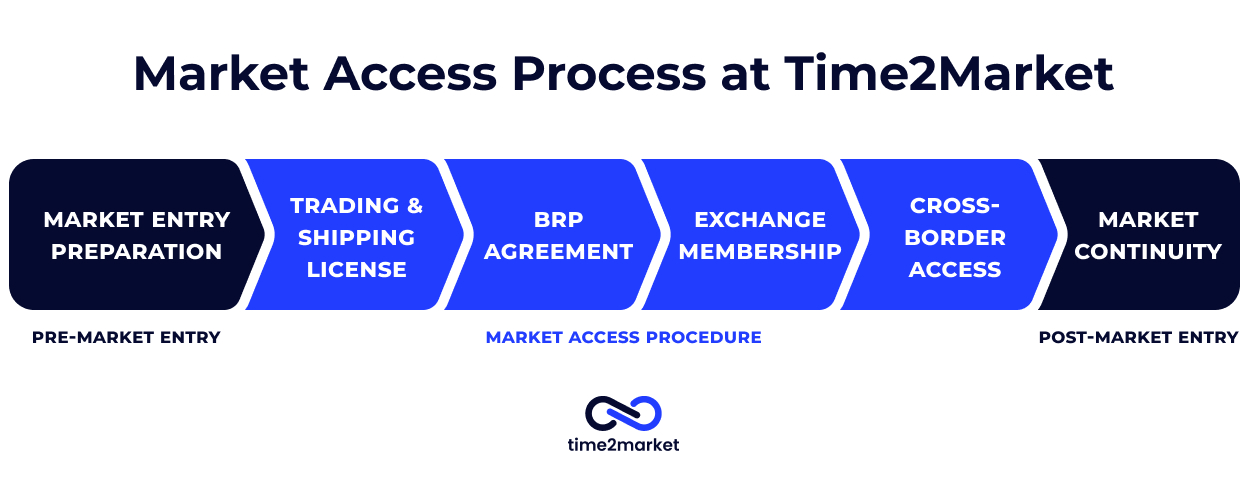
Many of these steps run in sequence, so a delay at one stage cascades quickly. For a closer look at that sequence, you can read our article on how to enter new energy markets →
The rest lies with the entrant. Incomplete applications are a common cause of delay. In some markets, an application that is not completed by the deadline is closed and has to be resubmitted, while processing only begins once the full application is in.
Internal processes add further time. Market access often requires sign-off from several departments, and legal teams may review each requirement and agreement in turn. A few days or weeks per requirement can quickly add up to months in cases where these internal procedures are not managed well by the owner of the market entry project.
Regulation in power and gas markets exists to protect security of supply, so its requirements are largely fixed and set out in advance. In our experience, delays rarely come from the rules themselves, but from uncertainty about how they apply to a specific setup. Entrants who treat these requirements as fixed parameters and plan around them move faster than those who try to resolve every detail before committing. Eszter further explores the relationship between the history of energy markets and how they handle entry requirements in her new book, Power Moves → You can find it in Chapter XIV.
Market access is often seen as a paperwork exercise. But administration truly accounts for only 20 to 30% of the work. The rest is strategy and execution, choosing the right market, setting up the right structure and preparing the people and systems that will trade.
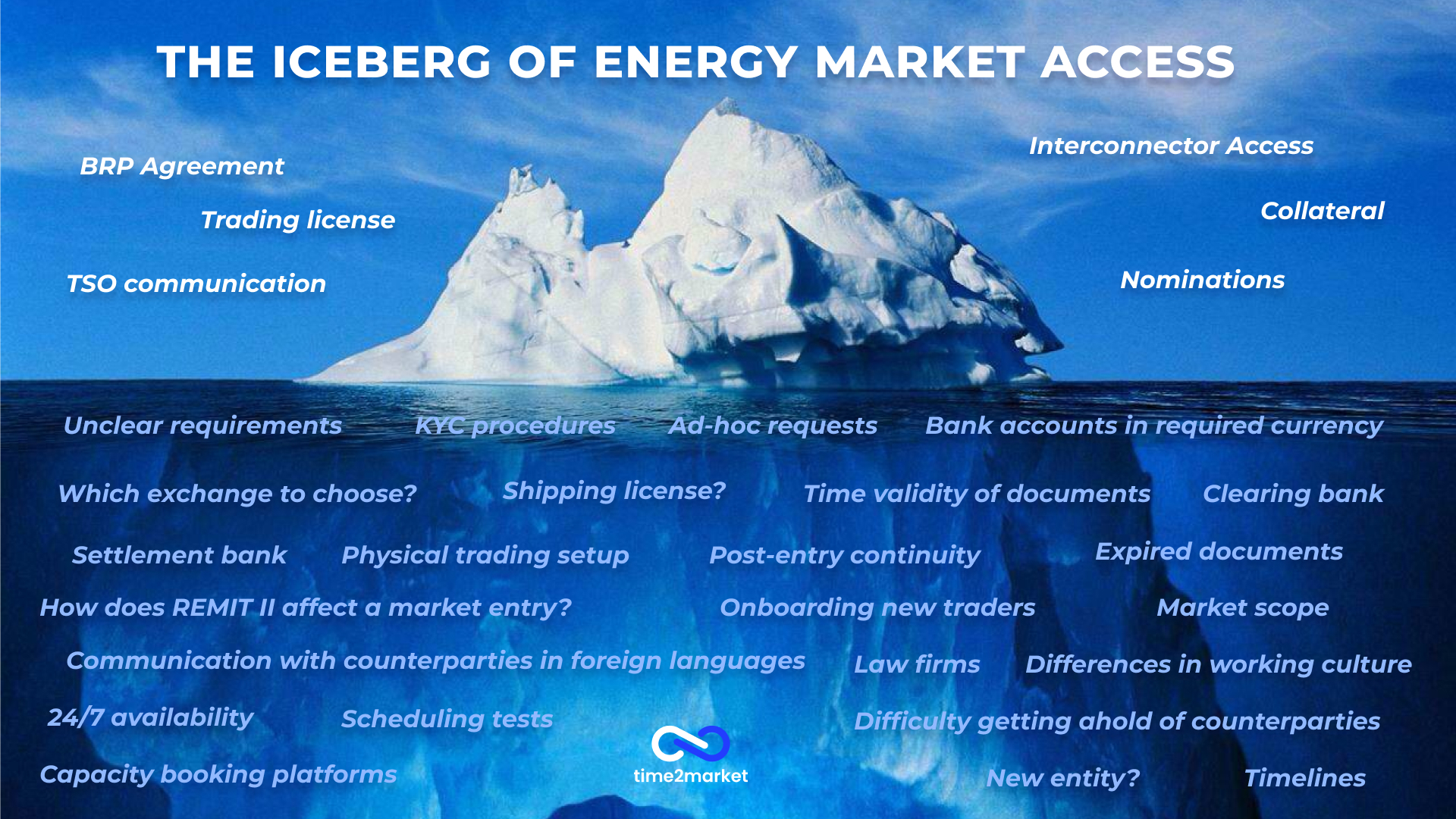
The same applies to the legal side. Most market access frameworks, from balance agreements to exchange rules, are standard terms with little room for negotiation. Where the terms cannot be changed, legal review can run in parallel with the rest of the setup rather than holding it up.
Most of the uncertainty that slows entrants down can be resolved before the first application. The decisions below shape a timeline more than any single registration step, and each is easier to get right at the start than to correct later.
Not every market allows every strategy. Some markets do not permit deliberate imbalanced positions; some do not allow assetless trading and others restrict specific trading activities. The same behavior can be treated very differently from one market to the next, even in the EU where a considerable part of regulation in energy markets is harmonized among EU members.
In some markets, BRPs must keep their portfolio balanced in every settlement period, while in others, the TSO financially rewards BRPs whose deviations help reduce the system imbalance. Grid codes are strict, and repeated breaches can lead a TSO to terminate a balance agreement and with it, access to the market. Serious breaches can also be a determining factor well beyond the market where they occurred. Sanction decisions for market abuse, for example, are published at an EU level.
Knowing what a market allows before committing up to a year and a considerable financial investment is what keeps that year from being lost and your reputation from being permanently damaged.
Legal entity requirements vary from market to market. Some markets accept applicants registered elsewhere in the region without a local branch; others accept foreign entities but require a local representative, and some even require a license holder to be a locally incorporated company.
This creates a trade-off. Being unwilling to open a local entity will block entry to many markets. Opening a new entity in every market by default, however, adds operational costs that compound with each expansion. Knowing these requirements in advance lets you find the setup that works for your organization across all your target markets rather than one market at a time. For entities registered outside of the EU, bank onboarding can add further delay, as covered in our article on how to speed up your entry to the energy markets →
Collateral is required at several points in the market access process, from TSOs and settlement providers to exchanges and clearinghouses, and how it is deployed matters as much as how much is available.
Cash collateral spread inefficiently across counterparties ties up capital that could otherwise support trading. A bank guarantee might seem like an obvious answer here until you experience how time-consuming establishing a relationship with a bank in a foreign market can be. And that's only in markets where both collateral mechanisms are available to market entrants.
Trading companies also need enough headroom to absorb ongoing costs and margin calls. A business case that only works with collateral at its minimum is at risk the first time the market moves against it.
Traders coming from FX, oil, metals or other commodities bring strong risk discipline and trading strategies, some even incredibly sophisticated infrastructure. Physical power and gas markets, however, add obligations that do not exist in most other asset classes. Physical delivery, highly granular products, scheduling and nominations, balancing, and imbalance exposure are all obligations that require dedicated systems and people who understand them.
Algorithms can automate much of the work, but they still need someone with energy trading experience to steer them. Building this capability before the first application rather than after avoids a gap between gaining market access and being able to use it.
Our upcoming webinar on the fastest route to your next energy market looks at how to work through these decisions early. You can register here →
The trading companies who move fastest share two traits: a clear vision and the ability to execute it. They know which markets they want to enter and why. Leadership is aligned behind the plan, and the right people are in place to set the strategy and carry it out.
They also treat uncertainty differently. Every market entry involves questions that cannot be fully answered in advance, from how a regulator will interpret an application to how a strategy will perform once trading starts. Fast entrants accept this as a fixed parameter and plan around it.
We have seen companies research a market for three years without entering it, while others with a similar starting point were live within six months. Choosing the right market for your strategy, setting up the right legal structure, deploying collateral effectively, and preparing your team for physical delivery are what decide whether an entry takes months or years.
In our upcoming webinar with Energy One, “The fastest route to your next energy market,” Eszter Pontenagel and Paul Pontenagel will join David Sierra and James Cummins to discuss how to plan and sequence a market entry, from licensing and BRP registrations to nominations, scheduling, and the technology needed to scale across energy markets.
Join us on October 8th at 12:00 CET. Register for the webinar here →
Our team of experts has developed an invaluable self-assessment tool based on over 300 successful market entries — so you know exactly where your organization stands before you make your next move.
✅ Takes just 8–10 minutes
✅ Completely free
✅ Receive your tailored report instantly
✅ Trusted by firms managing billions in AUM
Answer 30 questions and receive a personalized readiness report covering your strategic fit, regulatory exposure, financial requirements, and realistic timeline to first trade.

Disclaimer: Time2Market ApS is not responsible for the completeness, accuracy, and actuality of the information provided. This article is intended for informational purposes only and should not be considered business or legal advice. The energy industry is extremely dynamic and counterparties change their requirements frequently. As a result, information discussed on this page is subject to change without notice.
This page has last been updated on
October 6, 2026