
Article by
Eszter Pontenagel

Global power and gas trading activities span across dozens of national and regional markets, each with its own regulators, system operators, and market design differences. By just entering even a handful of markets, you will run into an endless list of counterparties, regulations and platforms that rarely share a name, let alone an acronym.
In this article, our experts have broken down the most common terms and abbreviations you will come across when entering and trading energy markets, what they mean, where they fit in, and which regions they apply in.
Every power and gas market has at least one national body responsible for licensing, oversight, and enforcement, but in many areas, there are state-specific regulators, regional bodies that oversee multiple markets, and agencies for cooperation between a number of regulators.
In the EU, energy market oversight starts at the national level, where a National Regulatory Authority (NRA) – a country-specific body such as Germany’s Bundesnetzagentur, or the UK’s OFGEM, grants market participants trading and shipping licenses (where applicable) and enforces local compliance.
Above the national layer sits the Agency for the Cooperation of Energy Regulators (ACER), where NRAs can coordinate, develop EU-wide network codes, and work to harmonize regulation across member states.
For a full breakdown of licensing and BRP requirements market by market, see our guide to EU-wide market access →
In the USA, oversight is split by function rather than geography. The Federal Energy Regulatory Commission (FERC) regulates the interstate transmission of electricity, natural gas, and oil, and answers directly to Congress.
Alongside it, the Commodity Futures Trading Commission (CFTC) regulates derivatives markets, policing fraud and manipulation in the financial instruments traders use to hedge their physical positions.
Reliability, rather than markets or licensing, falls to the North American Electric Reliability Corporation(NERC), which oversees system operators across the US, Canada, and northern Mexico.
In Canada specifically, the federal regulator is CER (the Canada Energy Regulator).
Japan splits the regulatory role in two: the Agency for Natural Resources and Energy (ANRE), which sets electricity and gas policy, and the Electricity and Gas Market Surveillance Commission (EGC), which monitors trading conduct and enforces market rules.
Australia uses a similar two-body split: the Australian Energy Market Commission (AEMC) writes and amends the rules that govern the market, while the Australian Energy Regulator (AER) enforces those rules and monitors compliance.
Markets are generally run by two bodies: a market operator (MO) which runs the tradeable wholesale market, and a system operator (SO) which operates the physical grid, often alongside supporting bodies like LNG system operators (LSO) or storage system operators (SSO).
Depending on the region, these two functions can sit inside a single entity, be split between separate entities that still cover the same territory, or be split between entities whose territories don't even match.
In the US, a single entity typically performs both roles under one of two labels: an Independent System Operator(ISO) manages grid scheduling and the wholesale market within its area, while a Regional Transmission Organization (RTO) does the same job under additional federal oversight from FERC. In practice the two terms are used almost interchangeably, and each of the seven North American operators runs its own combined grid-and-market operation:
Canada uses the same combined model, just under the label ESO (Electric System Operator) rather than ISO. Each is provincial rather than national: IESO (Ontario), AESO (Alberta),and NBSO (New Brunswick).
Mexico takes a different approach: rather than splitting the country into regional operators, CENACE (Centro Nacional de Control de Energía) is a single national ISO responsible for both the grid and the wholesale market across the entire country.

The EU splits the MO and SO functions. A Transmission System Operator (TSO) manages grid access in its area, balancing supply and demand in real time, and provides non-discriminatory connection to the network. A Distribution System Operator (DSO) handles the lower-voltage network that delivers power to end users below the transmission level.
On the market side, a Nominated Electricity Market Operator (NEMO) is an energy exchange formally nominated to run the mechanisms behind EU market coupling. Two EU-wide associations coordinate the national TSOs: ENTSO-E for electricity and ENTSOG for gas.
Whether the market operator and system operator share the same footprint varies by country. In Poland, the TSO (PSE)and the NEMO (TGE, the Polish Power Exchange) are separate entities, but both operate exclusively within Poland's borders. But this isn't the norm across the EU: Germany alone has four TSOs (Amprion, TenneT, 50Hertz, and TransnetBW), while EPEX SPOT, the exchange that sets German day-ahead prices, operates across 13+ countries.

In the UK, the equivalent system-operator role is called an Electricity System Operator (ESO), the same term used generally in Canada, though the two aren't related bodies.
Japan coordinates its grid through the Organization for Cross-regional Coordination of Transmission Operators (OCCTO), which oversees interconnection and supply-demand balance nationally, rather than leaving it to individual regional operators. Japan has ten regional transmission operators, one per historical utility service area: Hokkaido, Tohoku, TEPCO (Tokyo), Chubu, Hokuriku, Kansai, Chugoku, Shikoku, Kyushu, and Okinawa. Nine of these were legally unbundled from generation and retail in2020; Okinawa is the sole exception, remaining vertically integrated.

Australia consolidates the role into a single body: the Australian Energy Market Operator (AEMO) runs both the day-to-day grid and the wholesale market itself, across both electricity and gas. AEMO manages the Australian NEM (National Electricity Market) as five interconnected price regions rather than separate operators: Queensland, New South Wales (including the ACT), Victoria, South Australia, and Tasmania, each clears at its own price every five minutes, reflecting local generation mix and interconnector constraints between regions.

A Balance Responsible Party (BRP) isa market participant granted balance responsibility by the local TSO, which allows it to take physical positions within that TSO's operational area. The role comes with a financial obligation: any difference between what a BRP schedules and what it actually delivers or consumes is settled against system imbalance prices, and TSOs can penalize BRPs that cause repeated imbalances.
A Balancing Service Provider (BSP) supplies the reserve capacity that BRPs draw on to correct imbalances in real time, often via imbalance markets.

In gas markets, formal recognition as a Shipper is what allows a market participant to bid in capacity auctions on platforms like PRISMA. It is generally granted by an NRA.
Know Your Customer (KYC) is the due diligence process that counterparties like TSOs, ISOs, NRAs, and banks run before granting market access, aimed at verifying a company's identity, activities, and its Ultimate Beneficial Owners (UBOs). Applicants typically also need to fulfill a bundle of compliance requirements covering Anti-Money Laundering (AML), Anti-Bribery &Anti-Corruption (ABAC), and Counter-Terrorist Financing (CTF), an internationally required set regardless of which counterparty is asking. Complexity varies sharply by market and by the profile of the applicant. Our experts have previously broken down the KYC requirements in energy markets in this article →
A central counterparty (CCP) sits at the center of clearing: it interposes itself as the buyer to every seller and seller to every buyer in a cleared trade, absorbing counterparty risk so a default doesn't cascade through the market. Firms without direct CCP membership access clearing through a clearing member (CM) instead. Settlement is handled separately by a settlement or clearing bank. Whether clearing is mandatory depends on classification: a Non-Financial Counterparty (NFC)trading below the relevant threshold (NFC-) is exempt, while one exceeding it (NFC+) must clear just like a financial counterparty(FC) would.
Formerly the European Federation of Energy Traders (EFET), now renamed as Energy Traders Europe, EFET, is the industry body behind the standard contract templates most European power and gas trades are documented under. The rename took effect in 2024, on the association's 25th anniversary, but the standard agreements it publishes are still widely referred to as "EFET agreements" in the market, so both names remain in active use.
A Power Purchase Agreement (PPA) isa long-term contract to buy a fixed volume of power directly from a generator, giving both sides revenue and supply certainty outside the wholesale market.
A Contract for Difference (CfD)achieves a similar goal through a different mechanism: rather than physical delivery, it settles the difference between an agreed strike price and the actual market price.
Generators use CfDs to hedge price risk while still selling into the market directly, whereas a PPA replaces market exposure with a fixed buyer relationship.
Over-the-counter (OTC), or bilateral, trading covers deals negotiated between two counterparties, rather than matched through an exchange's order book. This gives both sides more flexibility on contract terms, but shifts more of the counterparty risk management onto the parties themselves.
Locational Marginal Price (LMP) is the price of power at a specific grid location, reflecting congestion and losses relative to the wider market. A Financial Transmission Right (FTR) hedges against that congestion, paying out the difference in LMP between two locations. Auction Revenue Rights (ARR) give holders a claim on the revenue FTR auctions generate, typically allocated to entities that already own transmission capacity. Installed Capacity (ICAP) refers to capacity market products that pay generators for being available to supply power in the US, rather than for the energy itself.
An Energy Trading & Risk Management (ETRM) system is the software backbone that tracks positions, deals, and risk exposure across a trading desk. You can read more about ETRMs and other systems in an energy trading desk here →
PRISMA is the EU's main gas capacity booking platform, where Shippers bid for pipeline and storage capacity.
JAO, the Joint Allocation Office, runs the electricity equivalent, allocating cross-border interconnector capacity to market participants.
An Independent Power Producer (IPP)generates electricity for sale into the wholesale market without also functioning as a retail utility. An aggregator pools smaller, often distributed energy resources into a position large enough to trade or bid into a market, for example a fleet of electric vehicles (EVs) or a battery energy storage system (BESS). A virtual power plant (VPP) is the most common form this takes: a network of assets like batteries and rooftop solar, coordinated as if they were one power plant.
You can read more about developments in renewable energy here →
The EU uses three to four layers of reserves, varying by market, to ensure the grid is always balanced.
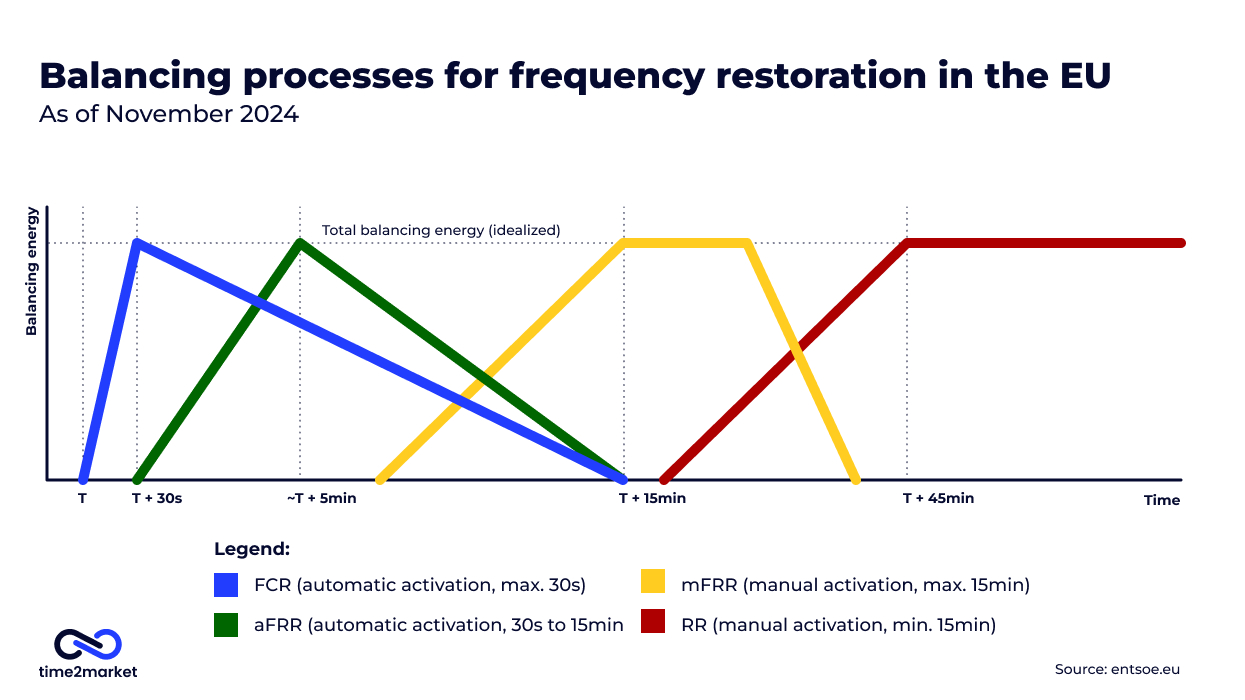
Frequency Containment Reserve (FCR) responds automatically within seconds to stabilize grid frequency, with no dedicated cross-border platform. Beyond that, three platforms connect national reserves: PICASSO exchanges automatic Frequency Restoration Reserve (aFRR), MARI exchanges manual Frequency Restoration Reserve (mFRR), and the Replacement Reserve (RR) which used to be exchanged on TERRE until March 2026. A fourth, IGCC, doesn't exchange reserve energy directly but nets out TSOs' imbalances against each other. Read more about the EU's balancing platforms in this article →
Market coupling links national markets so power flows where it's needed most, without traders booking cross-border capacity separately. EUPHEMIA is the algorithm calculating prices and flows across all coupled markets at once. Single Day-Ahead Coupling (SDAC) is managed by two separate systems that function in different ways and serve different markets: PCR (Price Coupling of Regions) and FBMC (Flow-Based Market Coupling). Single Intraday Coupling (SIDC) uses the XBID system. You can read about these systems in more detail here or in this Time2Talk episode →
Nominated Electricity Market Operators (NEMOs) carry out the Market Coupling Operator (MCO) function day to day, while Regional Coordination Centres (RCCs) supply the cross-zonal capacity feeding into it.
Reporting obligations in EU energy trading come from several overlapping frameworks, each with its own scope, regulator, and trigger conditions. Our whitepaper on reporting obligations breaks down how these apply across participant types
The energy industry’s love for abbreviations isn’t going away. If anything, each new interconnector, balancing platform, or reporting framework adds to it. Knowing what BRP, REMIT, or PICASSO stand for is one thing but navigating what they actually require when you're entering a new market is another.
Time2Market is an independent market management service provider specializing in onboarding high-frequency traders, capital managers, investment banks, renewable producers, utilities and retailers on physical power and gas markets. We handle full market access incl. license, BRP, exchange, interconnector, gas storage, and post-entry continuity.
You can take a look at how we work and which markets we support, test your energy trading readiness, or get in touch with us here →
Our team of experts has developed an invaluable self-assessment tool based on over 300 successful market entries — so you know exactly where your organization stands before you make your next move.
✅ Takes just 8–10 minutes
✅ Completely free
✅ Receive your tailored report instantly
✅ Trusted by firms managing billions in AUM
Answer 30 questions and receive a personalized readiness report covering your strategic fit, regulatory exposure, financial requirements, and realistic timeline to first trade.

Disclaimer: Time2Market ApS is not responsible for the completeness, accuracy, and actuality of the information provided. This article is intended for informational purposes only and should not be considered business or legal advice. The energy industry is extremely dynamic and counterparties change their requirements frequently. As a result, information discussed on this page is subject to change without notice.
This page has last been updated on
July 30, 2026